
Sponsored Content from SalesJack
Building permits are one of the clearest signals of future material demand in a dealer’s market. They show which projects are active, who’s building them, and how big the work is. For a growing lumberyard, permit-based sales means a better lead list, an earlier shot at upcoming work, and a heads-up when a current customer starts buying elsewhere.
Start with the economics of the job
On an average project, building materials run roughly 40% of total project value. That falls closer to 25% on large projects and climbs past 40% on small ones. Since no dealer supplies every category on every job, 30% is a workable estimate of what a dealer could actually sell.
That makes a $400,000 residential permit worth about $120,000 in potential material sales. A rep doesn’t need to win the whole package for the opportunity to matter. A framing package, a window order, or a millwork package can move the value of an account on its own.
The estimate also helps managers set priorities. A $40,000 permit and a $400,000 permit don’t deserve the same effort.
Find the builders with a pipeline of work
Permit records become available three to four weeks after approval. Some show up within a week; in slower jurisdictions it can take two or three months. A fast remodel may already be locked up by the time the data reaches a sales team.
But the data is worth more than a single job. Group permits by company and you can see which builders have a steady pipeline. A builder who has pulled 14 permits in the past three months belongs on the sales team’s list whether the dealer wins the current job or not.
Sales leaders should build a ranked list of the 50 to 100 most active builders in their territory, work out which are already customers, and flag the ones that fit the yard’s target profile. That list becomes the basis for jobsite visits, prospecting, and account planning.
Filter the list before it reaches a rep
Raw permit data is full of production builders, owner-builders, swimming pool jobs, work outside the service area, and contractors who already buy from the yard. Reps should get qualified opportunities, not a county spreadsheet.
Qualification should account for:
- Project type and estimated material value
- Geography and branch coverage
- Target builder profile
- Existing customer relationships
What’s a good sales target per rep? Aim for the Mendoza line
How much new business should leads produce? LBM sales coach Bradley Hartmann, whose firm recently partnered with SalesJack on LBM sales analytics, has a mark he calls the Mendoza line, after the baseball player whose .200 batting average became the floor for staying in the majors. His version for lumber reps: at least 10% of sales should come from new business. SalesJack data backs it up. Across the dealers we work with, stores growing 5% or more year over year usually have reps generating 10% to 15% of their sales from new business, while flatter stores sit in the low single digits. For a rep with a $2 million book, clearing the line means $200,000 to $300,000 in new revenue. Permit data is a main lead source for the teams that get there. Customers of SalesJack’s lumberyard CRM, like PARR Lumber, have closed more than $1 million in new sales in their first year working permit-based opportunities.
Put ownership and speed into the process
Every qualified lead needs an owner. Otherwise a contractor gets several calls from the same dealer, or none at all. Ownership can follow region, company type, or an existing relationship.
The teams that execute best set a response standard. Many give a qualified permit lead two or three days; others use a week. What matters is that everyone follows it. A lead that sits for a month won’t produce a useful sales conversation.
Managers should review outcomes every week: leads contacted, visited, quoted, won, lost. That creates accountability without turning the process into paperwork. A leaderboard helps when it counts qualified opportunities worked, new quotes, and new sales, not the number of records a rep opens.
Use jobsite visits to qualify the opportunity
For a cold lead in construction, showing up in person is often the best way to start earning trust. Contractors are making large, time-sensitive purchases, and a face-to-face introduction carries more weight than another phone call or email. A permit gives the rep a legitimate reason to visit, while the jobsite allows them to confirm whether the project is active, identify the builder or project manager responsible for purchasing, and understand whether there is still an opportunity to quote materials.
Even if the current job is already too far along, the visit creates an opening to ask about the contractor’s next project. Trust in the lumber business is built through repeated conversations, consistent follow-up, and reliable service. Permit data gives the rep useful context before the first meeting, but the in-person visit is what begins the relationship.

Run a blitz day
Outbound takes practice, and reps who haven’t worked permit leads before can find cold jobsite visits uncomfortable. Blitz days fix that. Pick a day, build routes so each rep can hit a lot of sites, and send the whole team out together, managers included. Hand out Gatorade and some brand swag, shake hands, and tell contractors what the yard does. Reps get a reason to be on site, and the first awkward visits turn into a team event instead of a solo grind. One dealer we work with had a rep close eight new customers in a single blitz day.
How AI fits
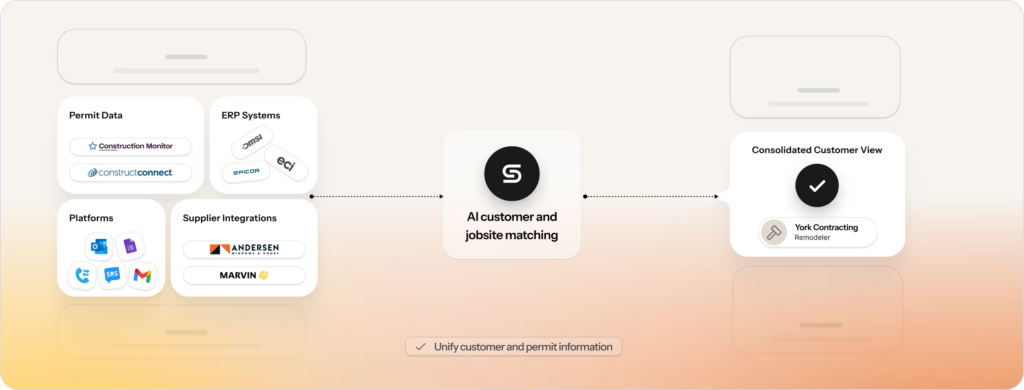
AI earns its place when it removes the manual work that keeps a sales team from acting on good information. In a permit workflow, that means cleaning and filtering incoming records, matching builders and projects against ERP data, removing jobs already sold, routing leads to the right rep, and tracking activity through to quotes and revenue.
SalesJack works this way. The platform sources permit data, filters it by construction type, geography, and builder profile, and matches it against the dealer’s ERP. Jobs already sold get removed, permits tied to existing accounts route to the rep who owns the relationship, and new leads reach the right salesperson with the context to act. That’s work that would otherwise fall to a sales manager with a county spreadsheet.
The sales team still has to make the call, visit the jobsite, and win the order. AI just puts a real opportunity in front of the right person sooner, and does it consistently.
SalesJack connects permit and ERP data to help building-materials dealers identify qualified opportunities, assign them to the right rep, and track the result. SalesJack is an analytics and CRM platform built for building-materials retailers. Learn more at SalesJack.com.